Skip to content

What was the Santa Fe Trail?

What was the Santa Fe Trail?

But establishing a border between Spanish and U.S. jurisdictions didn’t stop some Americans from crossing that border. It will be remembered that when young Zebulon Pike had set out to explore the Great Plains and the Rocky Mountains in 1806, he was unceremoniously arrested by Spanish troops in modern-day Colorado. Back then, isolationist Spanish authorities had jealously guarded their frontiers against perceived American incursions. Only a few years after Pike’s journey, however, Mexico erupted into revolution. What this development might mean for American travelers and traders, no one could say. Regardless, a vast, largely uncharted buffer territory separated Mexico proper from the United States. From the Missouri border established by the “Transcontinental Treaty,” hundreds of miles of plains—inhabited by bands of highly mobile and often hostile American Indians, none of whom had been party to the recent boundary negotiations—ran up against hundreds of miles of desert and mountains. All of this must be traversed before one could ever catch a glimpse of Santa Fe.

Enter William Becknell. Becknell had lived in Missouri for around a decade, making his way further and further west until finally setting himself up on the part of the Missouri River that marked the state’s western border. A veteran of the War of 1812 (during which he’d battled British-allied Fox, Sac, and Cree natives on the frontier), Becknell worked a farm, traded horses, and operated a ferry across the Missouri at  a place called Arrow Rock. Later he tried his hand at salt mining, and he speculated in land, too. To carry out his various enterprises, William Becknell borrowed a sizable amount of money. Credit was easy, after all.

A U.S. National Park Service map of the Santa Fe Trail, with a few additional labels added by me (in black)
Then came the Panic of 1819. As we’ve seen, monetary inflation, much of it in the form of unredeemable paper money, drove most people to hoard their gold and silver coin. Businesses shuttered. Banks collapsed. Loans were called in and credit contracted—and Becknell’s own creditors demanded payment in gold or silver. How would he come up with the money?

The standard hard-money unit circulating in the United States at the time was the Spanish dollar. Due to the Panic, these were now in very short supply. Becknell determined, then, to head west, deep into Spanish-controlled territory, to see if he could trade for silver coin. In August 1821, he placed an advertisement in the local newspaper. “W. BECKNELL” was captaining “[a] Company of 17 men…destined to the westward,” the notice read. The party hoped to increase its ranks to thirty. “On the first day of September the company will cross the Missouri at the Arrow Rock,” the notice informed its readers. Any who wished to join were instructed on where and when to meet.

But when the prearranged day arrived, only a handful of men—perhaps five—showed up prepared for the journey. Including Becknell himself, then, the company may have numbered a mere six.

The “Arrow Rock” ferry landing

Moving in a southwesterly direction, Becknell’s company crossed the plains of Kansas—meeting virtually no natives along the way—to the Arkansas River. Continuing west along the Arkansas, Becknell turned southwest again at the much smaller Purgatoire River (thereby missing Pike’s Peak by around 160 miles). The stream led them to an offshoot of the Rockies. The journey through these mountains was difficult, but on the other side a fantastical landscape of desert mesas, buttes, and canyons greeted Becknell and his company. 

Late 19th-century portrayal of an 1820 “pack train” to Santa Fe

Continuing southwest around a hundred miles, the men suddenly encountered a contingent of four hundred Mexican soldiers traveling in formation. The Mexicans’ ranks included local militia and Pueblo Indians, and they were led by a Captain named Pedro Ignacio Gallego. 

This was the moment of truth. Would this agent of the state, with a veritable army at his back, confiscate the Americans’ goods, deport them, or imprison them—as had been done to explorers and would-be American traders in the past? 

As it turns out, Gallego had been sent on patrol not to seek out trespassing Americans, but rather to counter a recent wave of violent raids by the Navajo and the Comanche against Mexican settlements in the area. Indeed, Gallego at that very moment had been tracking a marauding band of Comanches when he’d spotted Becknell and his company. In his diary (translated here from the original Spanish), Gallego later described the meeting with Becknell:

About 3:30 p.m. encountered six Americans at the Puertocito de la Piedra Lumbre. They parleyed with me and at about 4 p.m. we halted at the stream at Piedra Lumbre.  Not understanding their words nor any of the signs they made, I decided to return to El Vado… 

Becknell’s own account of the meeting adds more detail:

On Tuesday morning the 13th, we had the satisfaction of meeting with a party of Spanish troops [he didn’t yet know they were actually troops of Mexico, not Spain]. Although the difference of our language would not admit of conversation, yet the circumstances attending their reception of us, fully convinced us of their hospitable disposition and friendly feelings. 

The meeting was thus an amicable one, despite the language barrier, and Becknell came away convinced of the Mexicans’ “manifestations of kindness.” The two groups camped together that night, and the next day traveled together, too. Entering a town, a “grateful” Becknell noted that its inhabitants exhibited “civility and welcome.” It is likely that Becknell now learned of Mexican victory over the Spanish in their revolution. Mexico was independent. 

From here the Americans were allowed to continue their journey on their own, though Gallego later ordered a detachment of a hundred of his men to follow “the foreigners” from a distance, at least for a time.

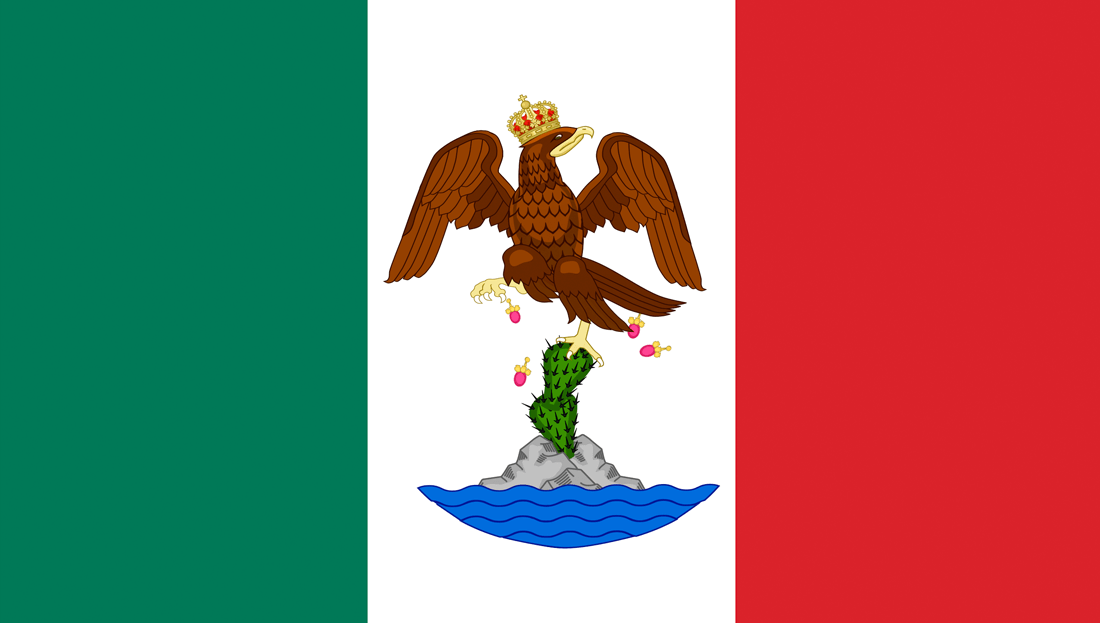
Flag of the Mexican Empire – Mexico seceded from the Spanish Empire in a protracted war of independence between 1810 and 1821. The war ended around the same time Becknell left on his intial Santa Fe journey.

Becknell spent several weeks trading with the highly receptive inhabitants of Santa Fe, offering calico cloth and other items from the States for Spanish dollars. On the way home to the United States, he traveled in a direct northeasterly direction (rather than following east-west or north-south river trails), which avoided mountains altogether in favor of a mostly flat, level path: the imposingly dry Cimarron Desert. Fortunately, the Cimarron River provided something of a watery path through this otherwise sand-sage country, though the river sometimes dried up completely.

Five months after his initial departure from “the Arrow Rock,” William Becknell crossed back into Missouri, his saddlebags filled with Spanish silver. A few hundred dollars’ worth of trade goods had been swapped for around six thousand dollars in hard coin. William Becknell’s debts could now surely be paid—indeed, several times over!—with money to spare.

But Becknell wasn’t finished. The next year, he returned to Santa Fe—this time, of course, opting for the Cimarron route. Crucially, he brought with him several covered wagons, the first ever to cross this territory. The trip took just 48 days, and apart from an ordeal involving the Osage Indians—who kidnapped three of Becknell’s party and tortured them before the Missourian managed to get them back—it appears to have been uneventful. Later accounts that Becknell and his men at one point almost died of thirst, only surviving by sucking the liquid contents out of crudely-removed animal stomachs, are of questionable authenticity. In any case, Becknell and company returned home from this second trip having earned 3,000% profits.

William Becknell had blazed the Santa Fe Trail

Later, he would help map it as a surveyor and guide. And for the next sixty years, it was some variation of Becknell’s wagon trail upon which countless travelers and traders moved goods between New Mexico and the east.

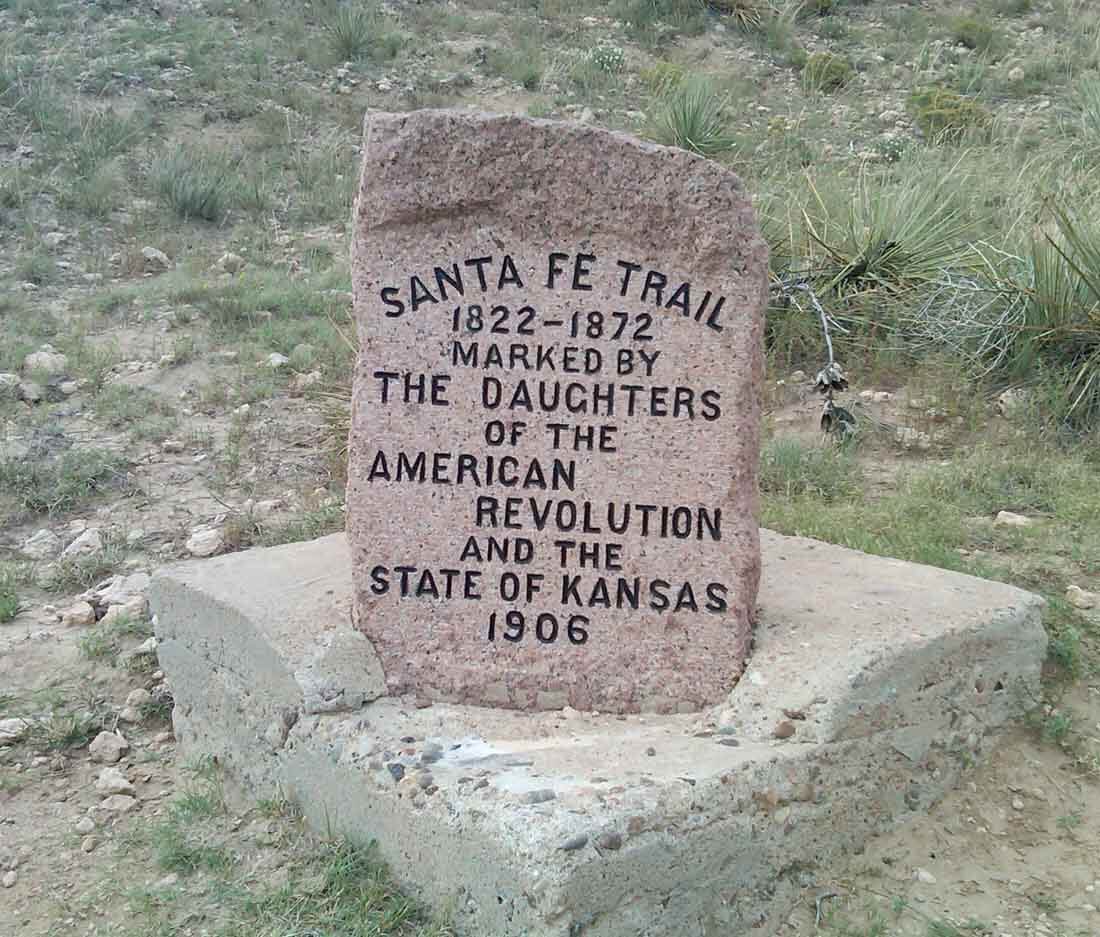
Modern-day stone marker in the Cimarron National Forest, along the route of the Santa Fe Trail

Sign up now for The Nomadic Professor’s newsletter to unlock 9 free research tools. Also receive course updates, learning tips, and exclusive offers!

The Nomadic Newsletter

Sign up now for The Nomadic Professor’s newsletter to unlock 9 free research tools. Also receive course updates, learning tips, and exclusive offers!

Session Feedback

Comments, corrections or questions on this session? Typos, broken links, unclear instructions? Exceptional content? Whatever it may be, we’d appreciate you sharing your feedback here.

Please note that this form is not required. If you do not have any feedback on this session, feel free to move on to the next!

Purchase: Bulk Discounts

Number of seats
Discount
Purchase per seat
1
$249
2–4
–25%
$186.75
5–9
–30%
$174.30
10–19
–35%
$161.85
20+
–40%
$149.40

Subscription: Bulk Discounts

Number of seats
Discount
Subscription per seat
1
$30 / month
2–4
–25%
$22.50 / month
5–9
–30%
$21 / month
10–19
–35%
$19.50 / month
20+
–40%
$18 / month

Comments? Corrections? Questions? Exceptional content? Whatever it may be, we’d appreciate you getting in touch.

Reach out to The Nomadic Professor!

Comments? Corrections? Questions? Exceptional content? Whatever it may be, we’d appreciate you getting in touch.

Free Course Previews

Sign up now for free access to sample sessions of The Nomadic Professor’s courses!