What was the Missouri Compromise?
By the time Alabama was admitted to the Union (December 1819), the Senate was divided evenly between the representatives of eleven “free states” (i.e. states that prohibited slavery, viz. Massachussetts, New Hampshire, Vermont, Rhode Island, Connecticut, New York, New Jersey, Pennsylvania, Ohio, Indiana, and Illinois) and eleven “slave states” (Delaware, Maryland, Virginia, North Carolina, South Carolina, Kentucky, Tennessee, Georgia, Louisiana, Mississippi, and Alabama). Missouri yet remained outside of the Union of states. Why? Alabama had been allowed to join, mostly without incident. Kentucky, Tennessee, Louisiana, and Mississippi had all been accepted before that, also without much ado. So why all the fuss specifically focused on Missouri?
Look at a map. There was no doubt about the status of a state like Alabama, or Mississippi, situated as they were in the deep South. But the vast majority of Missouri’s eastern border was shared by…Illinois! Missouri’s geographic location so far north was of great concern to the inhabitants of Northern states; would Missouri set a precedent for future states carved out of what was once the Louisiana Purchase? Was slavery to spread its tentacles far into the North, perhaps even one day hemming in the “free” states completely? Look at the map again. If admitted, Missouri would be the first state carved completely from territory lying west of the Mississippi River. Was the transcontinental future to be mired in slavery? Was that institution—and, perhaps more importantly, the politics of the South—to be spread north and west without any sort of check?
By early 1820, Congress had divided into obvious and sectional factions on the Missouri Question. Northerners, in particular those from New York and New England, openly attacked Missouri—and the South generally. Southerners, as a block, rushed to the defense of Missouri and their slave-dependent economic system. The impasse dominated national politics until 3 March, when, in large part thanks to the machinations of Speaker of the House Henry Clay, a multi-faceted legislative deal emerged known as the Missouri Compromise. The Compromise was made up primarily of the following concessions:
- Missouri would join the Union as a slave state, but
- Maine, carved out of Massachusetts, would join the Union as a free state. However,
- a line would be established running along 36 degrees 30 minutes latitude (i.e. 36°30′, the southern border of Missouri); as far as the Louisiana Purchase territory was concerned, any state created south of that line was permitted to practice slavery, but any state created north of it (excepting Missouri) was to be free.
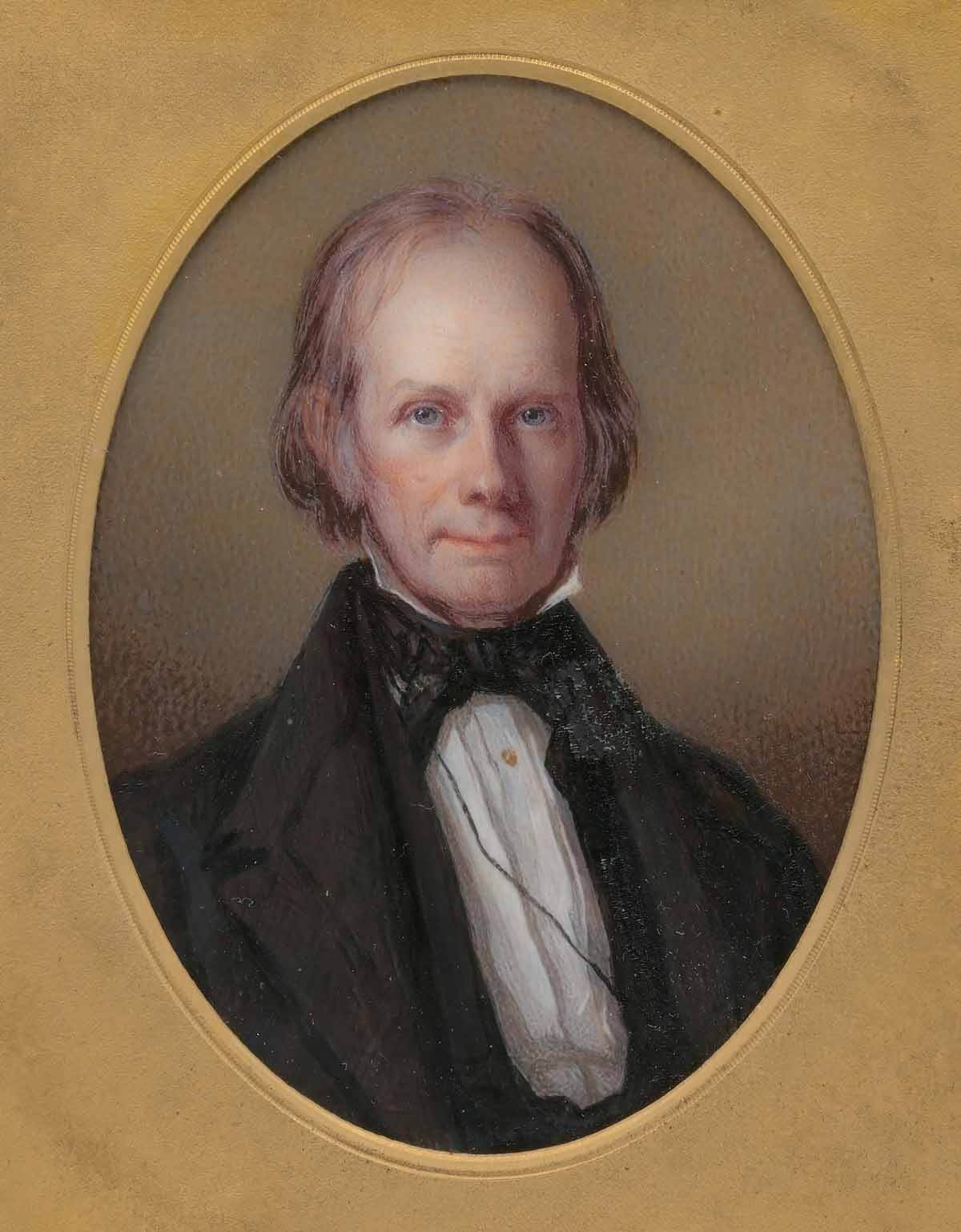
Henry Clay – Considered to have orchestrated both the Missouri Compromise and the so-called “Second Missouri Compromise” (portrait by Savinien Edme Dubourjal, c. 1845)