
Was the gold rush accompanied by a copper rush?
Natives of the Copper River area, in the region of the Wrangell Mountains, had collected and worked copper for almost a thousand years. Indeed, they maintained a virtual monopoly over copper goods, trading them for other goods from surrounding tribes.
During the gold rush, some stampeders branched out from the precious yellow metal to look instead for other minerals. Some determined to look for copper. Whites were aware of the existence of copper in Alaska, but only the natives of the Copper River—specifically, the clans of the Athabaskan-speaking Ahtna people—knew exactly where to look. In 1899, as most prospectors hunted for gold on the great gold fields of the Klondike or the emerging fields in far western Alaska, a few followed Chief Nicolai of the lower Copper River people to the copper deposits of the Chitina River valley. Scholars still puzzle at Nicolai’s willingness to reveal the location of the copper deposits—something that the Ahtna had kept strictly secret from the Russians in decades past—to these Americans. In any case, Chief Nicolai laid bare the Ahtna’s copper secrets. It turned out that, at least along some parts of the upper Copper River drainage, copper could be found literally lying on the ground! The copper rush was on.
In 1900, two prospectors on Bonanza Ridge, in the Wrangell Mountains, found the highest-grade commercial deposit ever discovered. An entrepreneur named Stephen Birch—who also happened to be a mining engineer—quickly negotiated for the purchase of the ridge claims. Teaming up with financial magnates J. P. Morgan and Daniel Guggenheim to form the “Alaska Syndicate,” Birch and his fellows determined to extract, process, and sell Bonanza Ridge’s copper. But the Alaska Syndicate would need infrastructure. Over the next few years, the Syndicate built a massive mine (for a time the largest in the world), a $23 million railroad, and managed a steamship company.
The gamble paid off. From 1911 to 1938, the company processed almost 5 million tons of copper ore, processing $200 million in copper and thereby reaping profits in the range of $100 million. The mine and its associated operations drew workers and settlers to the region. The railroad alone spawned the towns of McCarthy, Chitina, and Cordova. Even the profits from gold discoveries nearby paled in comparison to the profits from copper, at least in the area. “At the peak of operation,” the National Park Service informs us, “approximately 300 people worked in the mill town and 200-300 in the mines. Kennecott was a self-contained company town that included a hospital, general store, school, skating rink, tennis court, recreation hall, and dairy.”
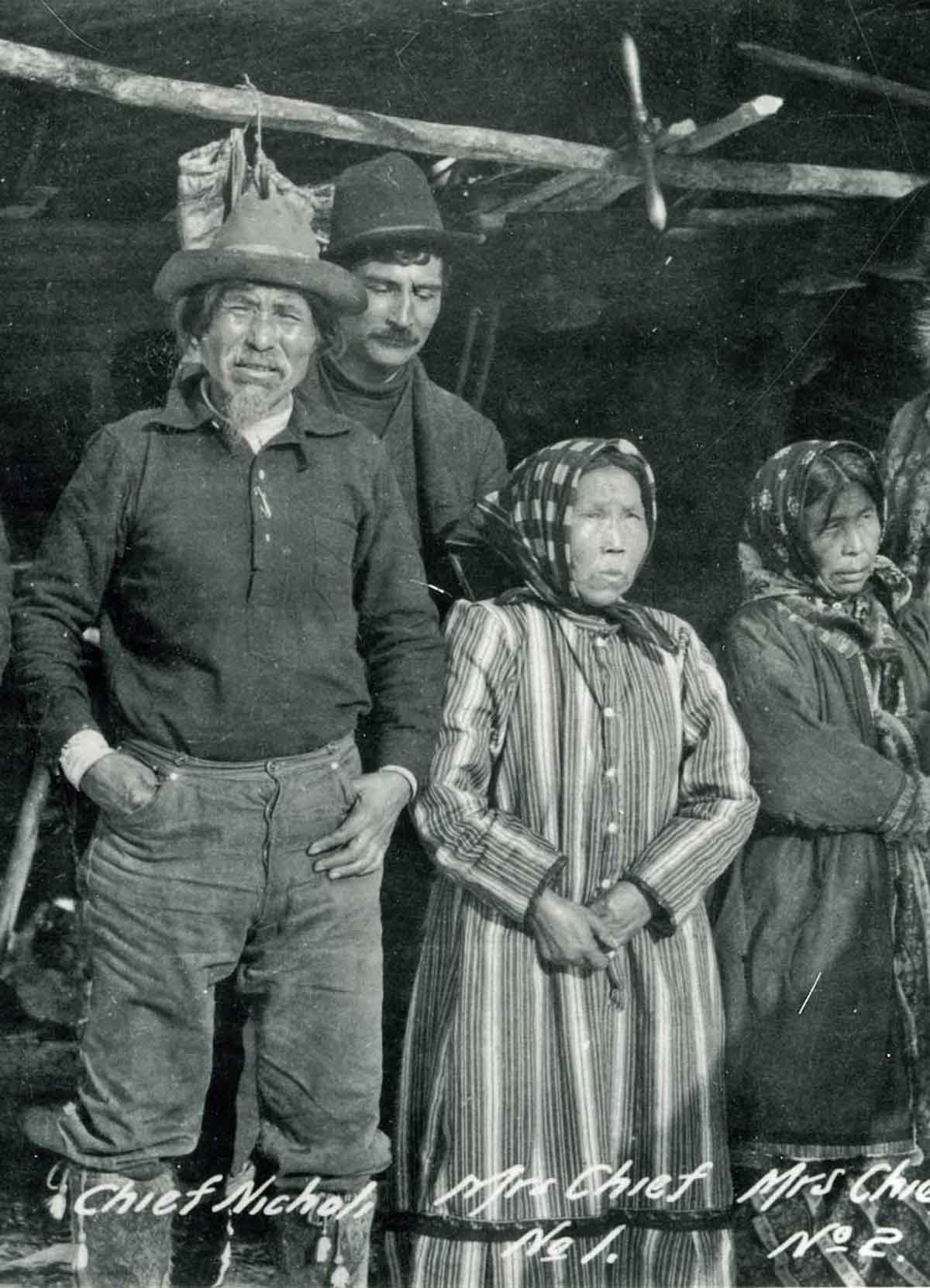
Chief Nicolai and his wives, identified as “Mrs. Chief No. 1” and “Mrs. Chief No. 2” (plus an unidentified man behind them)