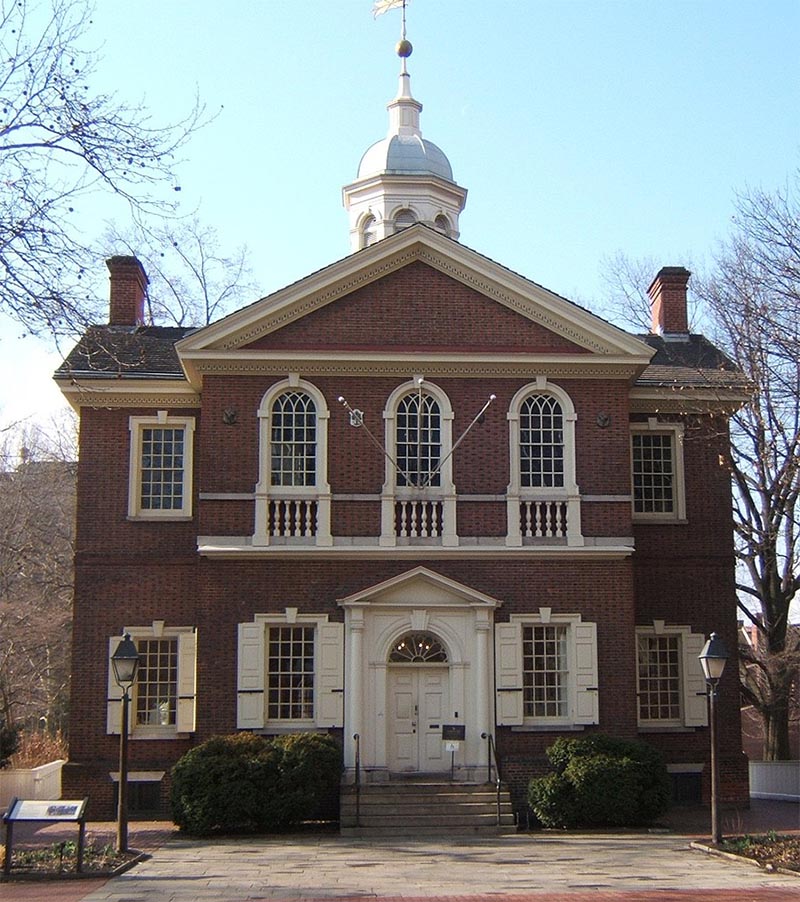
Jefferson’s Summary View was prepared in part for the Virginia delegates to the First Continental Congress. Committees of correspondence throughout the colonies had, by the summer of 1774, determined that a joint gathering must take place in order to discuss proper (and, hopefully, collective) action in the face of the British challenge to their rights as freeborn Englishmen. Fifty-five delegates were thus assembled in Philadelphia by early September, representing each of the colonies except Georgia; though that colony had sent no delegates, it nevertheless officially pledged to support the Congress’s decisions. Sam Adams was there, as was his less radical cousin, John. Ben Franklin ally Joseph Galloway attended as a Pennsylvania representative. Patrick Henry came, along with Richard Henry Lee and George Washington, from Virginia. Noted South Carolinian patriot Christopher Gadsden was present as well. This was a meeting of American luminaries perhaps unlike any before.
But that didn’t mean that agreement would come easy. While moderates (like Galloway) argued prudence and restraint, Sam Adams pressed for a showdown. After much back-and-forth, the radicals won the day, and the First Continental Congress adopted the Suffolk Resolves, a document delivered from Massachusetts to the Congress in Philadelphia by the fast-riding Paul Revere. This declaration, originally drafted by Suffolk County, Massachusetts, called for
- a general boycott of all British imports;
- a limiting of American exports to Britain;
- the nullification (i.e. ignoring) of the “Intolerable Acts”;
- the resignation of officials appointed under the Massachusetts Government Act;
- non-payment of taxes until the aforementioned Act was repealed;
- the formation of a separate, free colonial government for Massachusetts as long as the “Intolerable Acts” remained in effect; and
- the raising of militias in all American colonies.