
Notes and reflections on history and education
The next eight posts will wrap up our Media Literacy challenge for 2026. They’re going to be more historical than the previous posts in this challenge, because we’re going to explore a question that comes before any particular skill for reading online: What does it mean to “be informed”? This question arguably sits at the heart of all of the skills we’re trying to develop—if we have a strong argument for what it means to “be informed,” we’ll be better able to choose how we spend our time and what we spend our time with. I hope you’ll join us as we explore this difficult question!
Post Summary: Today’s popular injunction to “be informed” is often supported with quotations from colonial and Revolutionary American figures who are cited in tweet-length excerpts that unequivocally endorse our own conclusions about the importance of “the news.” But a little context reveals that these figures didn’t necessarily agree with each other, much less offer clear instructions for a world hundreds of years in the future.
It’s not hard to feel heavy pressure to “be informed.”
In 2017 the Washington Post famously adopted the slogan, “Democracy Dies in Darkness,” suggesting that a society without dogged journalists, or a public that ignores those journalists, will not be able to stay democratic.
The George W. Bush Presidential Center argues that being an “informed citizen” is an American “right and responsibility.”
Colonial Williamsburg staff argue that “The Founders” had a “Vision for an Informed Citizenry,” and goes on to suggest that we have an advantage over the founding generation because we have easy and virtually universal access to vast quantities of information, without regard to education, wealth, sex, or race.
The News Literacy Project launched a 2024 campaign called “Be informed, not misled,” and currently pitches itself as an important support in a child’s journey toward becoming “a thoughtful, informed citizen.”
For several years following the riot at the U.S. Capitol on January 6, 2021, PBS maintained a “Preserving Democracy” initiative, in which they enjoined readers to “be informed,” and advocated for U.S. diplomat Richard Haass’s Bill of Obligations: The Ten Habits of Good Citizens. The first habit in Haass’s list? Be Informed.
Op-eds argue for being informed, student papers chime in, social media posts poke around the edges, and civics textbooks reinforce public enjoinders.
To take it from even a superficial gloss of American educational, political, media, and cultural products, being informed is a foundational American value; so foundational that it doesn’t really need to be defined.
But scratch at the surface just a little and you’ll discover that what it means to “be informed” has no real definition at all, much less a set of instructions for how to do it. This was true in the past, and it may be true today. I’ll focus on just two examples.
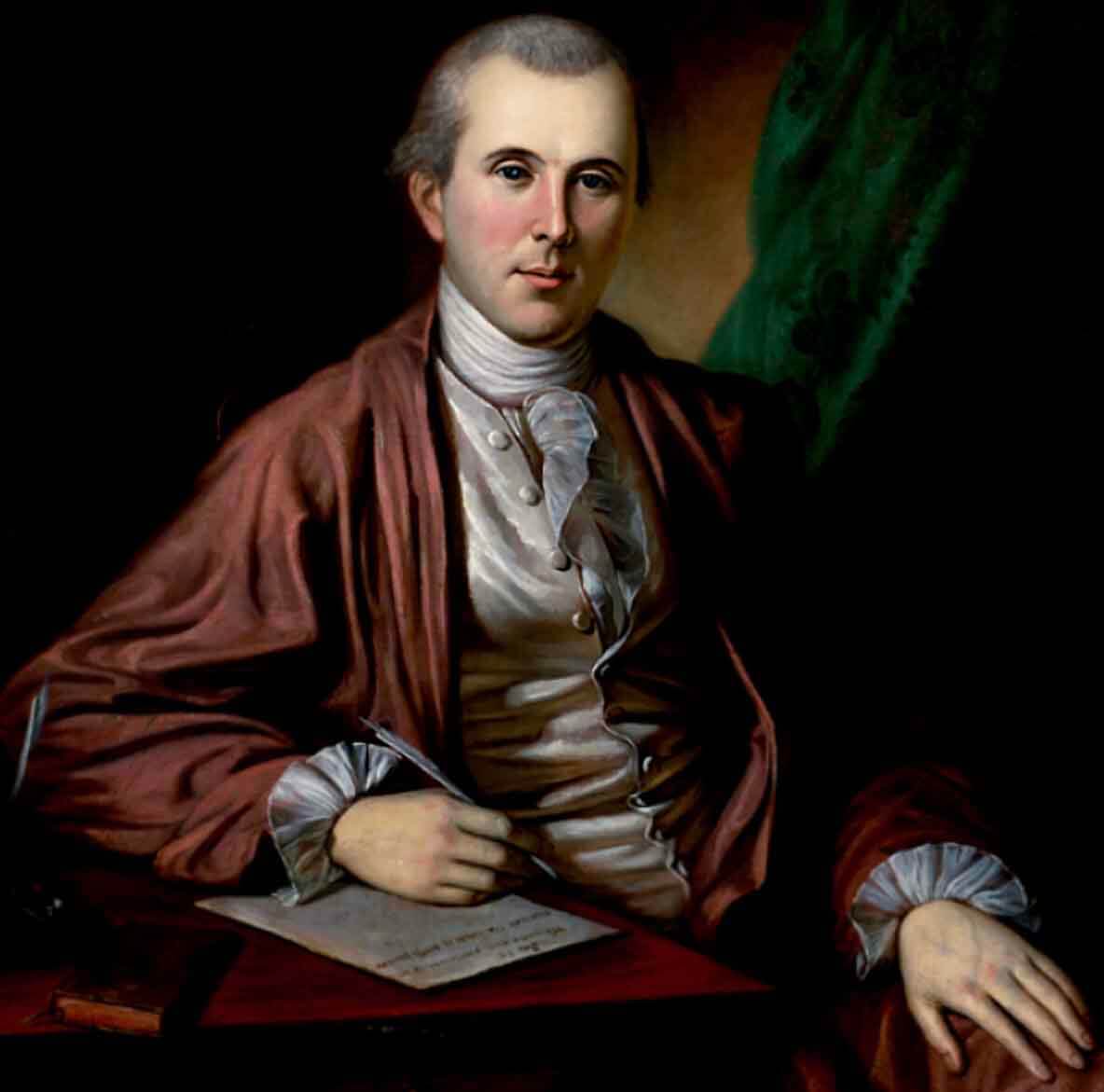
Portrait of Benjamin Rush, 1783
First, Colonial Williamsburg, a 300-acre “living history museum” in the historic district of Williamsburg, Virginia, cites a range of historical figures who advocate for an informed or educated citizenry (“informed” and “educated” are often treated interchangeably in this context), including Benjamin Rush. According to Rush, in an oft-quoted passage from his 1787 article, “To the Citizens of Philadelphia: A Plan for Free Schools” (quoted as published by Colonial Williamsburg):
“If the common people are ignorant and vicious, a republican nation can never be long free.”
On its face this reads like straightforward advocacy for a common understanding of good information and strong education, but we should avoid reading the present into the past, what sociologist Michael Schudson calls “rhetorical ancestor worship,” or “backdating”—the tendency to credit the founders with ideas that didn’t come into their present form until long after the founding period (Schudson, chs 1-2).
Here is what Rush said, quoted at greater length to avoid the kind of backdating Schudson describes:
To a people enlightened in the principles of liberty and Christianity, arguments, it is to be hoped, will be unnecessary to persuade them to adopt these necessary and useful institutions. The children of poor people form a great proportion of all communities. Their ignorance and vices when neglected are not confined to themselves; they associate with and contaminate the children of persons in the higher ranks of society. Thus they assist after they arrive at manhood in choosing the rulers who govern the whole community. They give a complexion to the morals and manners of the people. In short, where the common people are ignorant and vicious, a nation, and above all a republican nation, can never be long free and happy. It becomes us, therefore, as we love our offspring and value the freedom and prosperity of our country, immediately to provide for the education of the poor children who are so numerous in the thick-settled parts of the state…
SECONDLY, Let the children who are sent to those schools be taught to read and write the English and (when required by their parents) the German language. Let the girls be instructed in needlework, knitting, and spinning, as well as in the branches of literature that have been mentioned. Above all, let both sexes be carefully instructed in the principles and obligations of the Christian religion. This is the most essential part of education—this will make them dutiful children, teachable scholars, and, afterwards, good apprentices, good husbands, good wives, honest mechanics, industrious farmers, peaceable sailors, and, in everything that relates to this country, good citizens. (Rush, 413-414; emphasis added)
In context, it seems, Rush was advocating for taxes to fund schools for the poor, with a mix of logic that we would recognize—“education helps everyone choose the right people to govern them”—and logic that perhaps we wouldn’t—“we should use tax money to raise dutiful Christians.”
At the very least this fuller quotation complicates what we take away from Rush’s claim that the “ignorant and vicious” cannot long be “free and happy”; Rush seems to be saying that to “be informed” means to be a good Christian who can read and write, or, put another way, that one version of the informed citizen during the Founding period was actually the “morally upright” citizen, as opposed to the citizen who knew a lot about current events, could clearly and accurately recite the steps by which a bill becomes a law, or identify the members of his government at the city, state, or national levels.
Indeed, Rush’s letter was written in 1787, before the Constitution was ratified, before America’s bicameral legislature was instituted, before Washington became president, before the formal separation of church and state, before the birth of political parties, before the growth of the nation from the Atlantic to the Pacific, and before the full citizenship of women, slaves, and American Indians.
How would Rush qualify his remarks in light of the political and social changes of the last two-and-a-half centuries? We can’t know, but it certainly doesn’t clarify much to pretend that his world was the same as ours, or that what he means when cited out of context in 2026 is what he meant way back in 1787.
Second, PBS’s Preserving Democracy initiative cites Thomas Jefferson on “being informed”:
“…wherever the people are well-informed, they can be trusted with their own government.”

Portrait of Thomas Jefferson, 1800

Thomas Jefferson to Richard Price, January 8, 1789
As with Rush, this reads like a straightforward endorsement of some common understanding of what it means to “be informed.” But let’s look at the quotation in its full context. This quote comes from a letter Jefferson wrote in January 1789. He was writing to Richard Price, a British minister in London who supported the American Revolution, and their correspondence took place while Jefferson was serving a five-year stint as a diplomat in France. The quote above comes from a letter in which Jefferson is responding to Price’s praise for the American Constitution, which had been ratified by 11 of 13 states the previous year. Jefferson had only witnessed the Constitutional Convention and the ratification debates from afar, mostly through letters from Madison. It was in this context that he said:
Our new constitution, of which you speak also, has succeeded beyond what I apprehended it would have done. I did not at first believe that 11. states out of 13. would have consented to a plan consolidating them so much into one. A change in their dispositions, which had taken place since I left them, had rendered this consolidation necessary, that is to say, had called for a federal government which could walk upon it’s [sic] own legs, without leaning for support on the state legislatures. A sense of this necessity, and a submission to it, is to me a new and consolatory proof that wherever the people are well informed they can be trusted with their own government; that whenever things get so far wrong as to attract their notice, they may be relied on to set them to rights.
In context, then, Jefferson was referring to the American adoption of the Constitution in place of the previous Articles of Confederation, a change famously recommended by a Convention that arguably went far beyond its original assignment to modify the Articles. That convention, attended by 55 delegates, operated in complete secrecy from the outside world, far from the eyes and ears of any “well informed” public! Then followed Ratification, when “the people” of the various states had to decide if the new Constitution was something they really wanted.
In this excerpt Jefferson suggests that the states were right to ratify the Constitution. However, it’s unclear whether his confidence that the “well informed” who could “be trusted with their own government” referred mainly to (1) the state delegates from the ratifying states, (2) the segments of the population who could vote for those state delegates, or (3) the general population that engaged in public discussion and debate, whether or not they had a vote to cast.
On even the most generous reading—that there’s no need to nitpick like this, because with a little good-faith updating it’s clear that the spirit of his words translates to the 21st century regardless of his particular context—we’re left with questions: What did he mean by “informed”? People who follow Constitutional debates? Who approve of “consolidation” when necessary? Who know the newspaper headlines? Who vote? Who engage in spirited debate? Who are persuaded by the right arguments?
What if the so-called anti-federalists had won and the Constitution hadn’t been ratified—would that have meant the people were uninformed and not to be trusted with their own government, because they rejected his preference?
And what does he mean when he says “they may be relied upon” but only “whenever things get so far wrong as to attract their notice”? Is he suggesting that an informed citizenry only needs to be alert to the most egregious wrongs, but doesn’t have to stay on top of things in the meantime?
In any case, Jefferson’s letter seems to be relying on a different definition of “informed” than Rush was relying on just two years earlier. Where Rush emphasized morally upright, Christian citizens, Jefferson seems to be emphasizing a citizenry aware enough to spot egregious governmental wrongs of an unspecified type.
We could go on—Jefferson can be quoted to suggest that civil liberties, a free press, and informed people are critical to the functioning of the republic, and he can be quoted to suggest that the elite should rule and the press is a dishonest, attention-sucking business that is unworthy of your time, even actively harmful to your understanding. We could play a long game of “quote your Founder” to support a lot of things we want to believe.
But as we’ve seen, this kind of game doesn’t get us very close to a better understanding of what it means to “be informed” in the 21st century—indeed, it makes it harder to get close to a good understanding, since each new citation brings its own context and raises its own questions.
Historian of early America Richard D. Brown puts it nicely: “The actual lesson of the historical record is that no precise meaning for an informed citizenry has ever been established” (Brown, 205).
So where do we go from here? My hope is that we can work from this starting point to construct a definition of “being informed” that is useful for a conscientious person in the 21st century. These are the tentative topics I hope you’ll follow me through:
Talk soon!
Media Literacy Challenge 2026 – #17: What does it mean to “be informed”? (1)
Find all challenge key terms on Quizlet (the number of flashcards will increase as the challenge progresses!)
"Technology" is more than any particular tool. Fundamentally, technology is the tendencies...
Read More"Technology" is more than any particular tool. Fundamentally, technology is the tendencies...
Read MoreWhat do you think—are literate people only becoming more valuable, or are...
Read MoreLearn the posted definitions of “typographical culture,” “entertainment culture,” and “the medium...
Read MoreIn this latest installment, we look at three rules of thumb I...
Read MoreIn this latest installment, we take a look in the mirror to...
Read More“Journalism” is not some universal and unchanging ideal, sometimes reverently called “the...
Read MoreIf your only move after hearing a claim is to look into...
Read MorePolarization in the United States seems obvious—but what explains it, and is...
Read MoreWhen reading articles online, always ask: Is this outlet trying harder to...
Read MoreIf you use social media, this one’s a must: check out The...
Read MoreNote the expression, pay attention. You should take this pretty literally. The...
Read MoreSocrates famously worried about the invention of writing for the way it...
Read More“The real problem of humanity is the following: we have paleolithic emotions,...
Read MoreTo be literate with the media, we have to be honest about...
Read MoreIn 1983 Stanislav Petrov’s decision to “corroborate” the information his computer was...
Read MoreThe Nomadic Professor’s 2026 Media Literacy Challenge: Read Smarter Online! Twice a...
Read MoreNomadic Professor teaches history as method, not ideology: build knowledge, then master...
Read MoreWith the recent roll-out of the complete American History series by The...
Read MoreHow do we explore history without choosing sides? In tackling various angles...
Read More
We have sent a 6-digit verification code to your email. Please enter it below to continue.

Sign up now for The Nomadic Professor’s newsletter to unlock 9 free research tools. Also receive course updates, learning tips, and exclusive offers!
Sign up now for The Nomadic Professor’s newsletter to unlock 9 free research tools. Also receive course updates, learning tips, and exclusive offers!
Number of seats | Discount | Purchase per seat |
|---|---|---|
1 | — | $249 |
2–4 | –25% | $186.75 |
5–9 | –30% | $174.30 |
10–19 | –35% | $161.85 |
20+ | –40% | $149.40 |
Number of seats | Discount | Subscription per seat |
|---|---|---|
1 | — | $30 / month |
2–4 | –25% | $22.50 / month |
5–9 | –30% | $21 / month |
10–19 | –35% | $19.50 / month |
20+ | –40% | $18 / month |
We have sent a 6-digit verification code to your email. Please enter it below to continue.

Comments? Corrections? Questions? Exceptional content? Whatever it may be, we’d appreciate you getting in touch.
Comments? Corrections? Questions? Exceptional content? Whatever it may be, we’d appreciate you getting in touch.

Sign up once to unlock every free preview from The Nomadic Professor’s courses — no need to register again for each one! You’ll gain access to free course previews for US History, World History, Pirates, History of Alaska, and Media Literacy.